 Koifinance
 combines zkSync trading with liquidity pools, farming, bonds, and veDAO governance
Koifinance is a zkSync DeFi platform for token swaps, liquidity provision, farming, bonds, and veDAO governance. Its exchange uses pooled assets to support trades. Providers contribute liquidity, while selected farming programs offer additional rewards. Bonds let the DAO acquire liquidity, and locked KOI supports governance through veKOI. These functions connect around the same protocol, although each affects a different part of asset ownership, income, or voting control.
Token swaps and pooled trading
The automated market maker, or AMM, uses assets in liquidity pools to support token exchanges. A trader exchanges one asset for another. A liquidity provider contributes the capital that supports those exchanges and holds a position in the pool. These activities create different exposures, even when they involve the same assets. The exchange also includes limit orders among its documented functions.
A completed swap changes the assets that the trader holds. An LP position remains tied to the pool and its rules. LP means liquidity provider; an LP share represents participation in that pool. The pool design then determines how the contributed liquidity participates in trading.
Pool curves and active price ranges
Koifinance supports stable, normal, and concentrated pools, with designs that address different asset-price relationships or a provider's chosen trading range.
Stable and normal curves
Stable pools target assets that trade within a close price range. Normal pools address assets without that close relationship. Their curves shape exchange pricing, while neither classification guarantees that an asset maintains its value.
Concentrated v3 positions
Concentrated liquidity assigns capital to a selected price interval. A provider can hold several positions in one pool, each with its own range. This concentrates available liquidity around selected prices, rather than distributing that capital across the full price curve.
Price inside the range
An in-range position supplies active liquidity and can earn trading fees. Tick boundaries divide prices into discrete intervals, and the pool's fee tier affects permitted tick spacing. A position's lower and upper boundaries must fit those spacing rules.
Price outside the range
A position becomes inactive and stops earning trading fees when the pool price leaves its interval. A sustained price move can leave its liquidity entirely in one asset. If the price returns inside the interval, that liquidity becomes active again.
LP income and protocol charges
Pool fees and protocol fees use different calculation bases. A dynamic protocol fee takes a percentage of the LP pool fee. A fixed protocol fee uses a percentage of the overall trade.
In the documented v2 design, a fixed protocol fee above the pool fee leaves LPs without trading-fee income from that trade. Pool fees vary independently between pools, and LP governance can change them.
Farming beyond trading fees
Farming adds a separate reward program to selected liquidity pairs; a trading pool alone does not establish farming eligibility. The team and Koi DAO choose which pairs receive amplifiers. Each amplifier uses a static base annual percentage yield, or APY. An additional boost applies only when that amplifier enables it.
A configured boost compares the account's available vote-share value with its deposited LP value. The vote-share valuation uses the KOI price. The static base APY describes the amplifier's reward calculation, without fixing the exchange value of the deposited assets.
Amplifiers allocate rewards on deposit and disburse them gradually over a month through user redemptions. Withdrawing from an amplifier early forfeits its remaining unmatured rewards.
KOI locks and veDAO
KOI holders enter vote escrow by locking tokens into a veKOI NFT, whose voting weight reflects the amount and lock duration. NFT means non-fungible token. The position records its underlying KOI amount, voting weight, and expiry.
Koi DAO voting covers protocol-fee changes, farming allocations, bond offerings, and treasury control. These decisions concern the wider protocol. They differ from the LP governance that sets a particular pool's liquidity-provider fee.
Network and timing settings
Koifinance's documented parameters cover its contract network, token locks, and governance execution.
| Parameter | Documented value | Applies to | Required condition |
|---|---|---|---|
| Contract network | zkSync Era Mainnet | Listed DeFi contracts | Interaction on that network |
| veKOI lock duration | 7-728 days, in 7-day increments | KOI vote escrow | KOI committed to the lock |
| Bond payout lock | 7 days | Documented KOI-ETH LP bond | Sale of the eligible LP share for locked KOI |
| Governance execution delay | 2 days | Governor proposal execution | A passed proposal |
The Governor's two-day delay concerns execution of a passed proposal. Likewise, the documented bond lock belongs to that bond arrangement; it does not set the duration of every veKOI position.
Bonds and protocol-owned liquidity
Koifinance bonding exchanges a KOI-ETH LP share with the Koi DAO for KOI. The seller gives up the LP exposure, and the DAO acquires liquidity for the protocol. The documented bond pays KOI through a seven-day veKOI lock. Its quoted amount and vesting terms belong to the offer. Bonding therefore changes what the participant owns and when the KOI becomes accessible. A quoted discount concerns the exchange terms at purchase; later KOI price changes still affect the value of that exposure.
Gas payments through the paymaster
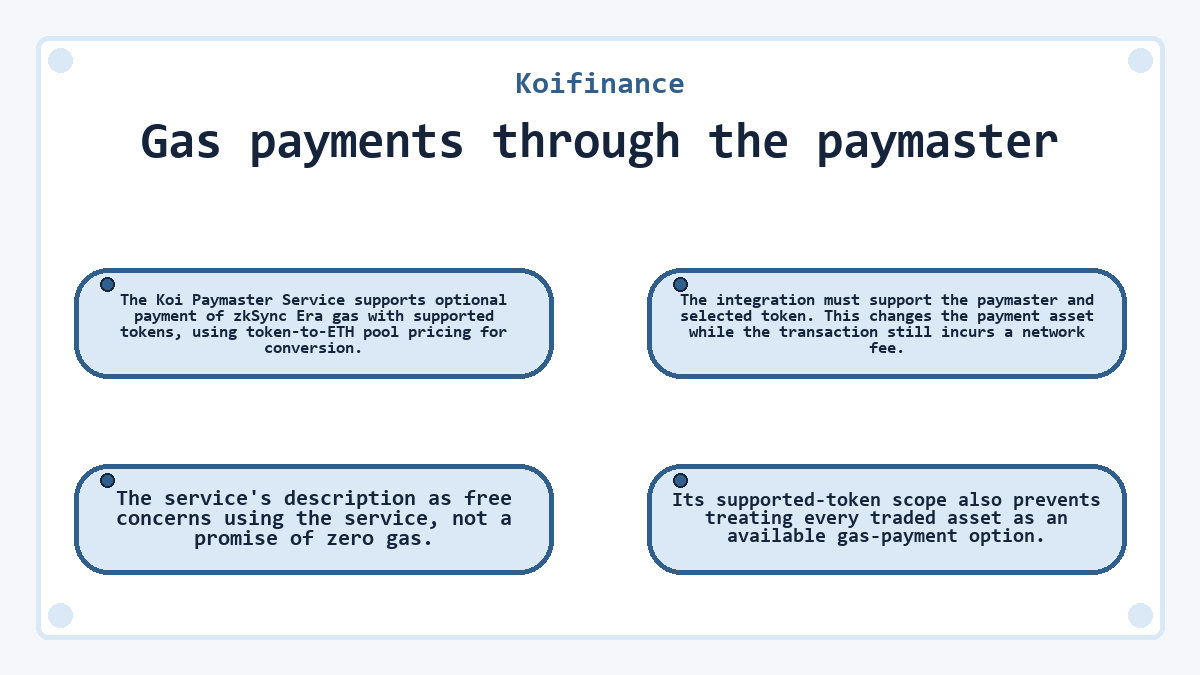
The Koi Paymaster Service supports optional payment of zkSync Era gas with supported tokens, using token-to-ETH pool pricing for conversion. The integration must support the paymaster and selected token. This changes the payment asset while the transaction still incurs a network fee. The service's description as free concerns using the service, not a promise of zero gas. Its supported-token scope also prevents treating every traded asset as an available gas-payment option.
How are Mute and Koifinance connected?
Mute was the earlier zkSync DeFi brand, and its core protocol work continues under Koifinance. Older integration material can retain Mute terminology. That history connects the names across the protocol's exchange, liquidity, and governance components.
Key questions about Koifinance
Do accrued v2 pool fees follow transferred LP tokens?
Accrued v2 pool fees remain associated with the holding account and do not transfer directly with LP tokens. External contracts that hold those tokens must call claimFees() before moving or receiving them and handle the fee distribution. Transferring an LP balance alone does not distribute its accrued fees.
Can the same vote shares support more than one amplifier?
The documented farming model carries an account's veKOI vote-share balance across amplifiers without splitting it between them. Each amplifier still assesses the applicable boost against its own deposited LP value and configured reward terms. Shared vote shares do not establish equal rewards across different pools.
Which contract holds the DAO treasury?
The Governor Timelock contract holds funds and owns other contracts within the documented Koi DAO setup. The Governor contract handles governance logic. This division separates deciding a proposal from executing its effects after the applicable delay, so a successful vote does not itself mean immediate treasury execution.
Is a veKOI position transferable during its lock?
The veKOI model allows the NFT to be transferred or sold while its underlying KOI remains locked. A transfer changes the position's owner; it does not remove the expiry condition for redeeming the underlying tokens.
What choices remain after a veKOI lock expires?
After expiry, the holder can redeem the underlying KOI by burning the veKOI NFT, continue holding the NFT, or redeem and establish a different lock. Expiry makes redemption available without requiring an immediate redemption.
Are private USDC payments on Base part of Koifinance?
Private USDC payments on Base belong to Senddy, a separate product from the same team. Koifinance's documented DeFi platform concerns zkSync trading, liquidity, farming, bonds, and governance. Sharing a team does not extend Senddy's payment or privacy features to those DeFi functions.
Does the 0% LP minting fee cover network gas?
The documented 0% LP minting fee does not include network gas. It describes the charge for issuing LP shares, while gas and fees on any included swap remain separate. Paying gas through a paymaster changes the payment asset without removing the network charge.
Updated ·